

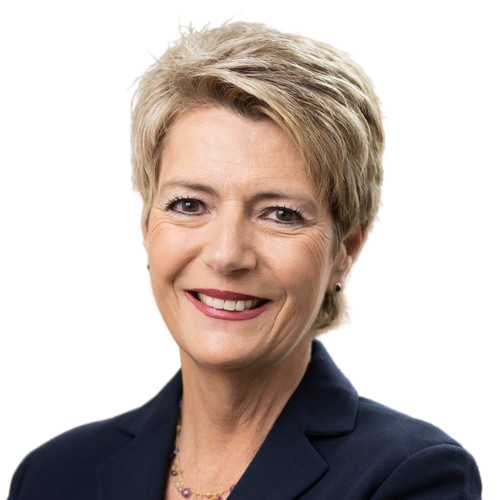
Hosted by
Karin Keller-Sutter
Federal Councillor & Head of the Federal Department of Finance, Switzerland

Peter Kerstens
Advisor, DG FISMA
European Commission
Peter advises on Technological Innovation, Digital Transformation and Cybersecurity at the European Commission’s financial services department. He has lead work on the European Commission’s Fintech Action Plan and Digital Finance Strategy and co-chaired the European Commission’s Fintech Taskforce. Peter is often referred to as the architect of Mica (the EU Markets in Crypto Assets Regulation) and Dora (the EU Digital Operational Resilience Act).
Peter has extensive experience in EU policy and regulation in a wide variety of fields, including single market, financial services, digitalisation, security, foreign policy sanctions, consumer protection as well as health and food safety. Earlier in his career, Peter was Finance Counsellor at the EU Embassy in Washington DC. He has also been a member of the private offices of the commissioner for the internal market and services and the commissioner for health and consumer protection. Before joining the European Commission, Peter advised major corporations on EU policy and regulatory affairs.
He is a Dutch national and holds double magna cum laude master degrees in European affairs and political science from the College of Europe in Bruges and the University of Leuven, Belgium. He is an Adjunct Professor of Law at Vanderbilt University Law School and a consummate public speaker.
Speaking at
-
2:00–3:00pmTue 23 JunWorkshopWorkshop Room, Level 1Open
Others
Resilience Runs on Trust: Securing Payments in an Uncertain World - Powered by Visa
-
 Agustín CarstensInternational Advisory Board Member, Global Finance & Technology Network (GFTN); Visa Economic Empowerment Institute Member, Visa; Board Member, UBS; Former General Manager, Bank for International Settlements (BIS)Bank for International Settlements (BIS)
-
 Aoife HoulihanVice President, Government AffairsVisa
-
 Christoph MüllerHead Banking Services & Member of the Executive BoardSIX
-
 Peter KerstensAdvisor, DG FISMAEuropean Commission
-
 Todd FoxPresident of Visa Economic Empowerment InstituteVisa
-
 Elizabeth MahoneySenior Director, International Financial OrganizationsVisaModerator
About this session
Today’s heightened geopolitical uncertainty (fragmentation, cyber risk, and macroeconomic volatility) is testing the resilience of the global payments system, which depends fundamentally on trust and security to function at scale.
This session explores how public authorities and the private sector can work together to preserve confidence, continuity, and cross-border connectivity through information-sharing, interoperable standards, and regulatory approaches that strengthen resilience without fragmenting the ecosystem. It also explores how Visa is innovating for resilience, including through offline solutions that safeguard transactions in low-connectivity or high-risk environments.
The discussion aims to highlight how security and fraud prevention are not peripheral issues but core pillars of payments resilience.
-
-
4:00–5:30pmTue 23 JunGFTN InsightsRoundtable Room 3, Ground FloorOpen
Empowering Entrepreneurship
The Future of Standard-Setting in Fintech Regulation
-
 Alisha ChhanganiAssociate Director, Future of MoneyAtlantic Council
-
 Aqsa ZubairDeputy Director, FinTech SupervisionBermuda Monetary Authority
-
 Camilla BullockChief Executive OfficerEmerging Payments Association Asia
-
 Chan Yam KiManaging Director, Asia PacificCircle
-
 Prof. Chris BrummerChief Executive OfficerFintech Foundation
-
 Karim MouaffakFinancial Sector SpecialistArab Monetary Fund
-
 Maha El DimachkiChief Executive Officer, GFTN SolutionsGlobal Finance & Technology Network (GFTN)
-
Peter KerstensAdvisor, DG FISMAEuropean Commission
-
 Tanvi SinghBoard Member, Advisor & FounderQubera AG
-
Todd FoxPresident of Visa Economic Empowerment InstituteVisa
-
 Prof. Yesha YadavBoard Member & ProfessorFintech Foundation, Vanderbilt Law SchoolModerator
About this session
Countries worldwide are competing to attract fintech investment, talent, and innovation. But understanding the quality of fintech regulation remains a work-in-progress. Are rules and institutions working in lockstep to promote fintech? Are these rules findable, coherent, and comprehensive enough to give firms, consumers, and supervisors genuine confidence? Can they promote innovation, market access as well as economic opportunity?
The Financial Regulatory Futures Index (FRFI) is a joint initiative of the Fintech Foundation and GFTN designed to fill that gap. Structured around five analytical pillars, the FRFI will assess regulatory environments not by perception or reputation, but by reference to verifiable primary sources: statutes, supervisory guidance, licensing frameworks, and enforcement records. Its methodology is being developed by five specialist working groups comprising leading regulators, central bankers, academics, and industry practitioners from over 30 jurisdictions. An Executive Council – comprising globally recognized thought-leaders and experienced policy innovators – will oversee the development of this initiative.
This roundtable will offer one of the first public windows into the emerging draft methodology, including how the Index defines and scores: regulatory clarity and comprehensiveness, consumer protection and market conduct, innovation and market infrastructure, resilience and integrity as well as economic opportunity and market access.
It will open a moderated discussion on the Index's intended policy impact, the trade-offs embedded in any cross-jurisdictional benchmarking exercise, and how the FRFI can best serve as a tool for peer learning and reform rather than as a simplistic league table. Feedback from regulators, practitioners, academics and subject matter experts in this conversation will inform the methodology ahead of its launch at DC Fintech Week in October 2026.
-
-
12:00–1:30pmWed 24 JunGFTN InsightsRoundtable Room 1, Ground FloorOpen
Blueprint for Digital Assets
Global Stablecoin Regulatory Frameworks: From Principles to Practice
-
 Emma ButterworthHead of Innovation & Payments PolicyBank of England
-
 Eszter MajorLawyerState Secretariat for International Finance
-
 Jo YeoDirectorMonetary Authority of Singapore
-
 Kwadwo BotweFintech SupervisorBank of Ghana
-
 Marianne BecharaSenior CounselInternational Monetary Fund
-
 Matthew OsborneDirector of Policy for EuropeRipple
-
 Nick GershSenior Regulatory CounselPaxos
-
 Patrick HansenSenior Director, EU Strategy & PolicyCircle
-
 Peter GoodrichMember of SecretariatFinancial Stability Board
-
Peter KerstensAdvisor, DG FISMAEuropean Commission
-
 Stephanie CabossiorasChief Strategy & Global Policy OfficerSociete Generale-FORGE
-
 Jannah PatchayExecutive in Residence & Board MemberGlobal Digital FinanceModerator
About this session
The January 2026 publication of the GDF Global Stablecoin Regulatory Playbook marked a pivotal moment in the evolution of digital asset oversight. For the first time, a comprehensive, principles-based framework has been developed, by and for stablecoin issuers, to establish shared terminology, foundational concepts, and outcome-oriented principles for stablecoin regulation across jurisdictions.
Yet the core challenge identified by the Playbook remains urgent: despite growing convergence on broad objectives, significant divergence persists in legal classification, terminology, reserve requirements, and redemption standards across the US (GENIUS Act), EU (MiCA), UK, Singapore, UAE, and beyond.
This fragmentation creates compliance burdens for global issuers, undermines cross-border scalability, and risks undercutting the very benefits - frictionless payments, financial inclusion, monetary efficiency - that stablecoins are positioned to deliver.
This roundtable convenes regulators, policymakers, and senior industry participants to analyse the GDF Playbook's findings, stress-test its recommendations against real regulatory experience, and identify actionable pathways toward greater international alignment.
Why Now?
Stablecoins have moved decisively from experiment to infrastructure. The GENIUS Act has established a federal US framework; MiCA has come into force across the EU; Singapore, Hong Kong, the UAE, and the UK have each enacted or are finalising their regimes. The window for shaping global interoperability, before these frameworks calcify into divergent silos, is narrow.
The GDF Playbook provides a neutral, issuer-grounded reference point from which regulators, policymakers, and industry can build shared understanding. This roundtable is designed to translate that reference point into regulatory action - identifying where equivalence determinations are ripe, where supervisory cooperation agreements should be deepened, and where international standard-setters should focus their attention.
-
-
2:00–3:30pmThu 25 JunGFTN InsightsRoundtable Room 2, Ground FloorOpen
Blueprint for Digital Assets
Building a Practitioner's Guide for Tokenization in Finance: Oversight Panel Convening
-
 Dr. Abbas AlbashaSenior Strategy Consultant CBDCGiesecke+Devrient (G+D)
-
 Dr. Alexandra HachmeisterDirector General Digital EuroDeutsche Bundesbank
-
Alisha ChhanganiAssociate Director, Future of MoneyAtlantic Council
-
 Amira KarimHead of International Public Policy, Payments & Financial ServicesAmazon
-
Aqsa ZubairDeputy Director, FinTech SupervisionBermuda Monetary Authority
-
 Arena FernandezHead of Digital Regulatory InitiativesAmazon
-
 Ariadne PlaitakisDeputy Director, Regulation, Policy, & ResearchGates Foundation
-
 Bilal Bin SaqibChairmanPakistan Virtual Assets Regulatory Authority
-
 Bridget Rose Mesina-RomeroDirector, Payments Policy and Development DepartmentBangko Sentral ng Pilipinas
-
 Chad HarperHead of Coinbase InstituteCoinbase
-
 Daisuke TerayamaDeputy Director-General, Head of Fintech CenterBank of Japan
-
 Emma JoyceChief Revenue OfficerGlobal Blockchain Business Council (GBBC)
-
 Ivan Mortimer-SchuttsGlobal Head of vLEIGlobal Legal Entity Identifier Foundation (GLEIF)
-
 Kevin CowanMember of the BoardCentral Bank of Chile
-
 Dr. Mark StaplesChief Technology OfficerDigital Finance CRC
-
 Matilda Asante - AsieduSecond Deputy GovernorBank of Ghana
-
 Michael MaurerResearch EngineerMIT Digital Currency Initiative (DCI)
-
 Mo JalilHead of Institutional PrivacyEthereum Foundation
-
 Natalya ThakurFounder & Chief Executive OfficerKnova
-
 Pallavi ThakurDirector, Digital Assets Industry EngagementSwift
-
Peter KerstensAdvisor, DG FISMAEuropean Commission
-
 Sébastien Van CampenhoudtDirector, Innovation & Digital Assets, Tokenized Cash LeadEuroclear
-
 Steve VallasChief Executive OfficerBlockchain APAC
-
 Sunayna TutejaFormer Chief Innovation OfficerFederal Reserve System
-
 Tang WeiHead of Public Policy, Southeast Asia & Greater ChinaStripe
-
 Toh Wee KeeGlobal Head of InsightsKinexys by J.P. Morgan
-
 Wee Kiat GohOpen Innovation LeadJulius Baer
-
 Jael TanHead of Government ProgrammesGlobal Finance & Technology Network (GFTN)Moderator
-
Maha El DimachkiChief Executive Officer, GFTN SolutionsGlobal Finance & Technology Network (GFTN)Moderator
About this session
Tokenization is reshaping financial infrastructure across many economies. The decisions that are being made now on architecture, standards and governance will determine whether that infrastructure serves developed and emerging and developing economies, or leaves some behind. Ensuring that outcome requires senior public sector voices at the centre of these conversations.
This session brings both working groups and the public sector Oversight Panel together for the first time. Working group leads will present their confirmed problem statements on what the evidence shows, and receive feedback and recommendations that working groups will pursue to build the practitioner's guide that will publish at Singapore FinTech Festival in November 2026.
About the initiative
GFTN is launching _Tokenization in Finance: Evidence and Implementation Pathways_, a structured, multi-stakeholder initiative convening two working groups drawn from leading financial institutions, infrastructure providers, and market participants to assemble a practitioner-oriented evidence base spanning spanning digital money and payment rails through to tokenized real-world assets, securities, funds, and capital markets infrastructure. At Singapore FinTech Festival in November 2026, the initiative will publish a practitioner guide designed to give financial institutions a structured basis for sequencing their digital asset strategies, and to equip regulators and finance ministries in emerging and developing economies with implementation pathways they can draw on directly.
-

