.svg)
Hosted by
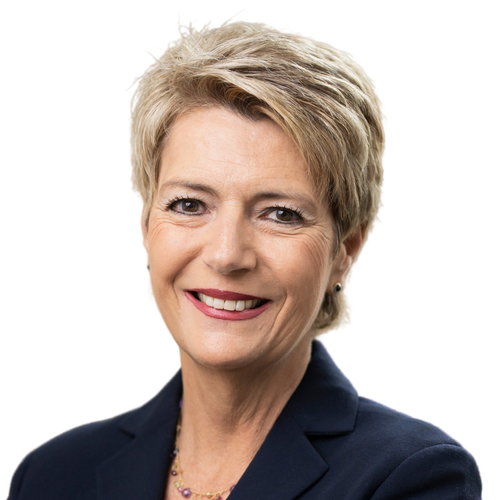
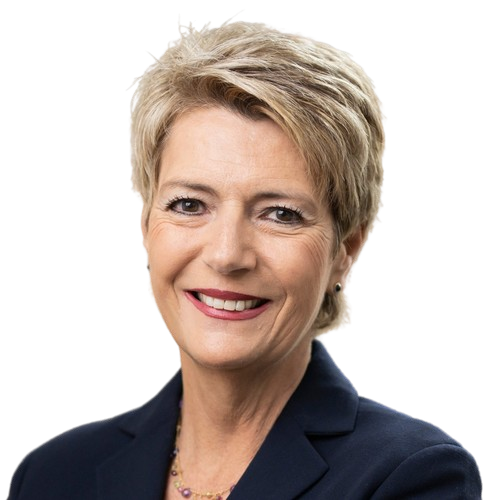
Karin Keller-Sutter
Federal Councillor & Head of the Federal Department of Finance, Switzerland
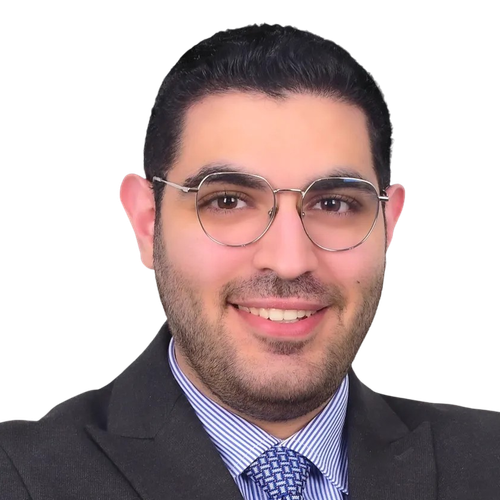
Karim Mouaffak
Financial Sector Specialist
Arab Monetary Fund
Karim Mouaffak is a financial sector specialist with expertise in regulatory innovation, financial strategy, and institutional transformation. His work focuses on supporting financial sector development and the strategic adoption of emerging technologies across the MENA region.
With a background in law and financial regulation, Karim built his career at the intersection of banking, payments, and financial technology, combining regulatory knowledge with a practical understanding of financial innovation.
Early exposure to central banking provided a strong foundation in monetary and supervisory systems and shaped his focus on policy-driven financial innovation.
Over time, he has developed a profile that combines regulatory expertise with strategic and operational insight, enabling institutions to navigate complex transformation agendas.
Karim's experience spans regulatory authorities, financial institutions, and regional initiatives, where he contributes to policy dialogue, institutional reform, and innovation-led financial sector development.
Speaking at
-
4:00–5:30pmTue 23 JunGFTN InsightsRoundtable Room 3, Ground FloorOpen
Empowering Entrepreneurship
The Future of Standard-Setting in Fintech Regulation
-
 Alisha ChhanganiAssociate Director, Future of MoneyAtlantic Council
-
 Aqsa ZubairDeputy Director, FinTech SupervisionBermuda Monetary Authority
-
 Camilla BullockChief Executive OfficerEmerging Payments Association Asia
-
 Chan Yam KiManaging Director, Asia PacificCircle
-
 Prof. Chris BrummerChief Executive OfficerFintech Foundation
-
 Karim MouaffakFinancial Sector SpecialistArab Monetary Fund
-
 Maha El DimachkiChief Executive Officer, GFTN SolutionsGlobal Finance & Technology Network (GFTN)
-
 Peter KerstensAdvisor, DG FISMAEuropean Commission
-
 Tanvi SinghBoard Member, Advisor & FounderQubera AG
-
 Todd FoxPresident of Visa Economic Empowerment InstituteVisa
-
 Prof. Yesha YadavBoard Member & ProfessorFintech Foundation, Vanderbilt Law SchoolModerator
About this session
Countries worldwide are competing to attract fintech investment, talent, and innovation. But understanding the quality of fintech regulation remains a work-in-progress. Are rules and institutions working in lockstep to promote fintech? Are these rules findable, coherent, and comprehensive enough to give firms, consumers, and supervisors genuine confidence? Can they promote innovation, market access as well as economic opportunity?
The Financial Regulatory Futures Index (FRFI) is a joint initiative of the Fintech Foundation and GFTN designed to fill that gap. Structured around five analytical pillars, the FRFI will assess regulatory environments not by perception or reputation, but by reference to verifiable primary sources: statutes, supervisory guidance, licensing frameworks, and enforcement records. Its methodology is being developed by five specialist working groups comprising leading regulators, central bankers, academics, and industry practitioners from over 30 jurisdictions. An Executive Council – comprising globally recognized thought-leaders and experienced policy innovators – will oversee the development of this initiative.
This roundtable will offer one of the first public windows into the emerging draft methodology, including how the Index defines and scores: regulatory clarity and comprehensiveness, consumer protection and market conduct, innovation and market infrastructure, resilience and integrity as well as economic opportunity and market access.
It will open a moderated discussion on the Index's intended policy impact, the trade-offs embedded in any cross-jurisdictional benchmarking exercise, and how the FRFI can best serve as a tool for peer learning and reform rather than as a simplistic league table. Feedback from regulators, practitioners, academics and subject matter experts in this conversation will inform the methodology ahead of its launch at DC Fintech Week in October 2026.
-
-
5:10–5:40pmWed 24 JunForum StageKongresssaal, Level 1Open
Blueprint for Digital Assets
Introducing the FinTech Regulatory Futures Index: A Global Benchmark for the Future of FinTech Regulation
-
Camilla BullockChief Executive OfficerEmerging Payments Association Asia
-
Prof. Chris BrummerChief Executive OfficerFintech Foundation
-
Karim MouaffakFinancial Sector SpecialistArab Monetary Fund
-
Maha El DimachkiChief Executive Officer, GFTN SolutionsGlobal Finance & Technology Network (GFTN)Moderator
About this session
Every year, trillions of dollars move through fintech markets governed by rules that no one has systematically measured, compared, or ranked across sectors.
At PZF 2026, the Fintech Foundation and GFTN introduce the FinTech Regulatory Futures Index, the first rigorous, evidence-based benchmark that measures regulatory quality across jurisdictions.
The Index aims to function as a public-interest instrument and a call to action for every market that wants to lead. Built with regulators, practitioners, and academics from over 30 countries, the Index is designed to become the definitive global reference point for what good fintech regulation looks like, and what it costs when it falls short.
-
-
2:00–3:30pmThu 25 JunGFTN InsightsRoundtable Room 3, Ground FloorOpen
Blueprint for Digital Assets
Navigating the New Digital Order: Regulatory Divergence, Monetary Architecture, and a Path toward Coordination
-
 Audrey MetzgerDirector of Innovation & Financial Market InfrastructuresBanque de France
-
 Dante DisparteChief Strategy Officer and Head of Global Policy & OperationsCircle
-
 Isadora ArredondoVice President, Global PolicyHedera
-
 Jessica RenierManaging Director & Head of Digital FinanceInstitute of International Finance (IIF)
-
Karim MouaffakFinancial Sector SpecialistArab Monetary Fund
-
 Dr. Michael HuertasPartner, Global FS Legal LeaderPwC Legal
-
 Mykolas MajauskasGlobal Head of PolicyBybit
-
 Natalya ThakurFounder & Chief Executive OfficerKnova
-
 Pavle AvramovicDirector of Research & PolicyFinancial Innovation for Impact
-
 Prof. Sarah HammerCo-ChairBretton Woods Committee Working Group on AI
-
 Thorsten PauliCountry Executive Switzerland, & Head Equity Capital Markets DACHBank of America
-
 Emily SlaterExecutive DirectorBretton Woods CommitteeModerator
About this session
Digital assets, programmable money, and AI-driven transactions are crossing borders at increased speed. But the rules governing them are being written jurisdiction by jurisdiction, with no shared architecture in sight. As the US advances GENIUS Act rules for private-sector stablecoins, the EU deepens MiCA and pursues a digital euro, and China scales its state-backed e-CNY, three major economies are building divergent governance frameworks around one underlying technology — with significant implications for cross-border payments, monetary policy transmission, and AI in the global financial system.
This policy divergence is a compliance challenge for market participants, but it is also the early stage of a structural buildup. When domestically rational policy choices generate internationally costly spillovers — and when no coordinating mechanism exists to manage them — fragmentation compounds over time until the cost of inaction becomes prohibitive. Digital currencies and AI governance are following this trajectory, and while the window to get ahead of it remains open, it is closing.
Against this backdrop, the Bretton Woods Committee will convene a closed roundtable at Point Zero Forum on Thursday, June 25th to bring together global policymakers, central bankers, regulators, and private sector leaders to stress-test the diagnosis. This discussion will directly inform the Bretton Woods Committee's upcoming work, with a focus on the defining digital governance challenge of the moment: whether coordination across jurisdictions can accelerate to match the digital rails being built beneath the global financial system.
The roundtable will be a 90-minute discussion featuring 10 minutes of scene-setting remarks from featured speakers, followed by an open exchange among the broader group. A brief framing paper will be circulated in advance. The core question animating the discussion: What are the costs of continued fragmentation — and what global coordination mechanisms are necessary to manage the associated risks and opportunities?
-