

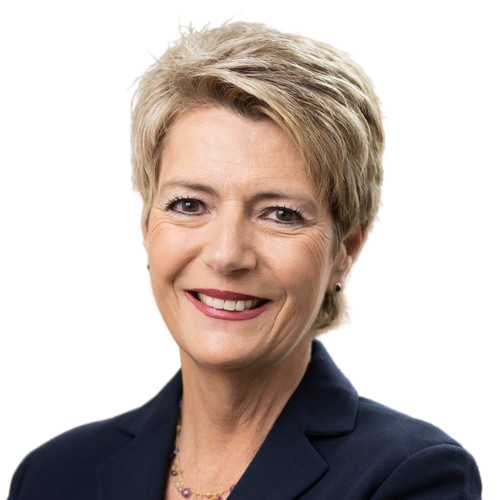
Hosted by
Karin Keller-Sutter
Federal Councillor & Head of the Federal Department of Finance, Switzerland

Jesse McWaters
EVP, Head of Global Policy
Mastercard
Jesse McWaters leads Mastercard’s global policy function, where he is responsible for directing the company’s policy strategy on a wide range of issues including CBDCs, cross-border payments, crypto-assets, real-time payments, open finance, digital ID, cyber-security, and fraud. Prior to joining Mastercard, Jesse served as Financial Technology & Innovation Lead at the World Economic Forum and as a financial services strategy consultant at Deloitte, supporting large-scale technology transformations and the roll-out of new business models for leading banks, insurers, and wealth managers.
Speaking at
-
12:00–1:30pmTue 23 JunGFTN InsightsRoundtable Room 2, Ground FloorOpen
Roadmap for AI and Quantum
Agentic Commerce: Who Governs the Machine that Pays?
-
 Amira KarimHead of International Public Policy, Payments & Financial ServicesAmazon
-
 Chan Yam KiManaging Director, Asia PacificCircle
-
 Colin PayneHead of InnovationFinancial Conduct Authority (FCA)
-
 Dea MarkovaDirector of PolicyFireblocks
-
 Georg SchneiderGlobal Head of RWADigital Asset
-
 Jesse McWatersEVP, Head of Global PolicyMastercard
-
 Dr. Mansour AlsalehGeneral Director for Innovation HubSAMA
-
 Nicole SandlerChief Ecosystem OfficerUbyx Inc
-
 Simon TaylorGTMTempo
-
 Sophie GilderManaging Director, Blockchain & Digital AssetsCommonwealth Bank Australia
-
 Tang WeiHead of Public Policy, Southeast Asia & Greater ChinaStripe
-
 Thibault MurelCISODFNS
-
 Jaskaran BhallaHead of ContentGlobal Finance & Technology Network (GFTN)Moderator
About this session
AI agents are already initiating real financial transactions - booking, subscribing, settling, and disbursing without a human approving each step. The commerce and payments infrastructure built around human decision-makers was not designed for a counterparty that never sleeps, cannot be held to a contract in the traditional sense, and can be compromised at the model layer rather than the credential layer.
This session convenes payments architects, legal practitioners, and AI deployment leads to work through the practical questions the industry is looking to answer: how do you authenticate an agent, assign liability for an autonomous transaction gone wrong, and design governance frameworks for a technology that is already in production.
Participants will examine the specific mechanics of agentic payment flows - wallet delegation architectures, spending limit enforcement, multi-agent authorisation chains, and the emerging standards around agent identity that are still being written in real time by consortia that have not yet reached consensus.
The session will also surface the fraud and risk management implications: how transaction monitoring systems designed to flag anomalous human behaviour respond to the high-frequency, pattern-consistent activity of a well-functioning agent - and what entirely new risk frameworks may be required when the buyer is a model, the merchant is an API, and the dispute resolution process was designed for neither. -
-
2:00–3:30pmWed 24 JunGFTN InsightsRoundtable Room 3, Ground FloorOpen
Blueprint for Digital Assets
Digital Money Meets Traditional Finance: Treasury, Cash Management, and Liquidity
-
 Dr. Alexander ThomaHead of Digital AssetsPostFinance
-
 Alvinder SinghHead, Innovation Acceleration OfficeMonetary Authority of Singapore
-
 Arjun Vir SinghPartner, Global Head of Fintech & Digital AssetsArthur D. Little
-
 Ashley BarnesHead of European Regional Treasury Centre CountriesHSBC
-
 Ceridwen ChooChief Executive OfficerCleanverse International Pte Ltd
-
Jesse McWatersEVP, Head of Global PolicyMastercard
-
 Lamine BrahimiCo-founder & Managing PartnerTaurus
-
 Laura LohDirector, Portfolio Strategy & Risk Group Office; Director, Investment (Blockchain)Temasek
-
 Rahul AdvaniGlobal Co-Head of PolicyRipple
-
 Richard van ReesExecutive Director, Digital Money ProductsUBS
-
 Serena SebastianiGroup Chief Strategy & Venture Officer, Head of Regulatory AffairsFuze
-
 Yoyee WangGlobal Head of B2BByBit
-
 Steve VallasChief Executive OfficerBlockchain APACModerator
About this session
Stablecoins have crossed $300 billion in circulation. Tokenized deposits are live at various global banks. Yet for all the headline numbers, the hard question remains unanswered: how do programmable money instruments actually integrate with the treasury operations, correspondent banking relationships, and payments infrastructure that keep traditional finance running?
This session convenes senior practitioners from banks, corporates, and digital asset firms to examine the real friction points - legal, operational, and technical - where digital money collides with TradFi plumbing, and where the integration is showing progress. Participants will discuss strategies to scale the integration of digital assets within traditional operations, including updating risk management frameworks, adhering to regulatory requirements, and architecting interoperability across systems.
-
-
4:30–5:10pmWed 24 JunForum StageKongresssaal, Level 1Open
Others
Towards Trusted Global Payment Infrastructure for a Multi-Asset Economy
-
Chan Yam KiManaging Director, Asia PacificCircle
-
 Dawei WangSenior Vice PresidentThunes
-
Jesse McWatersEVP, Head of Global PolicyMastercard
-
 Lu YinHead of APACSolana Foundation
-
 Mykolas MajauskasGlobal Head of PolicyBybit
-
 Lindsey ArgalasChief Executive OfficerTaxbitModerator
About this session
As financial flows increasingly move across fiat, stablecoins, and tokenized assets, the infrastructure supporting global value transfer is rapidly evolving. From settlement networks and on/off ramp infrastructure to multi-asset treasury and liquidity flows, institutions are rethinking how value moves across borders in a more digital, always-on economy.
But scaling these systems globally requires trusted governance, regulatory alignment, and coordinated technical standards that allow value to flow across jurisdictions. This session convenes infrastructure providers and financial institutions to explore what will be needed to support the next phase of global connectivity and adoption.
-

