

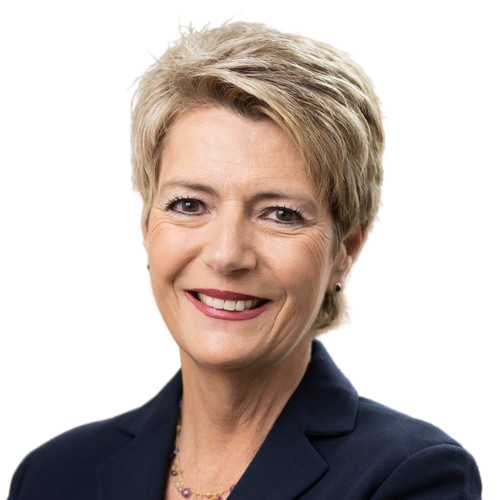
Hosted by
Karin Keller-Sutter
Federal Councillor & Head of the Federal Department of Finance, Switzerland

Prof. Yesha Yadav
Board Member & Professor
Fintech Foundation, Vanderbilt Law School
Yesha Yadav is Board Member of the Fintech Foundation, Professor of Law and Associate Dean at Vanderbilt Law School. Her expertise focuses on market structure, exchange design, financial innovation and payments. She writes and speaks extensively on the oversight of crypto-markets, blockchains, decentralized finance, and stablecoin payment ecosystems. Before joining Vanderbilt's Law faculty, Professor Yadav worked as a legal counsel with the World Bank in its finance, private-sector development and infrastructure unit, where she specialized in financial regulation and insolvency, and creditor-debtor rights. Before joining the World Bank, she practiced in the London and Paris offices of Clifford Chance in the firm's financial regulation and derivatives group. As part of her work in payments regulation, she advised the European Payments Council on the establishment of the Single Euro Payments Area. Professor Yadav has served as honorary advisor to India’s Financial Services Law Reform Commission and on the Atlantic Council’s Task Force on Divergence, Transatlantic Financial Reform and G-20 Agenda. She has served as a member of the Commodity Futures Trading Commission’s Technology Advisory Committee, where she served as Vice-Chair of the Distributed Ledger Technology Subcommittee and was a member of the Algorithmic Trading Subcommittees. Professor Yadav is a current member of Nasdaq’s Hearing Panel and the Board of Advisors of the Digital Dollar Project. She is also a board member of the Fintech Foundation.
Speaking at
-
4:00–5:30pmTue 23 JunGFTN InsightsRoundtable Room 3, Ground FloorOpenModerator
Empowering Entrepreneurship
The Future of Standard-Setting in Fintech Regulation
-
 Alisha ChhanganiAssociate Director, Future of MoneyAtlantic Council
-
 Aqsa ZubairDeputy Director, FinTech SupervisionBermuda Monetary Authority
-
 Camilla BullockChief Executive OfficerEmerging Payments Association Asia
-
 Chan Yam KiManaging Director, Asia PacificCircle
-
 Prof. Chris BrummerChief Executive OfficerFintech Foundation
-
 Karim MouaffakFinancial Sector SpecialistArab Monetary Fund
-
 Maha El DimachkiChief Executive Officer, GFTN SolutionsGlobal Finance & Technology Network (GFTN)
-
 Peter KerstensAdvisor, DG FISMAEuropean Commission
-
 Tanvi SinghBoard Member, Advisor & FounderQubera AG
-
 Todd FoxPresident of Visa Economic Empowerment InstituteVisa
-
 Prof. Yesha YadavBoard Member & ProfessorFintech Foundation, Vanderbilt Law SchoolModerator
About this session
Countries worldwide are competing to attract fintech investment, talent, and innovation. But understanding the quality of fintech regulation remains a work-in-progress. Are rules and institutions working in lockstep to promote fintech? Are these rules findable, coherent, and comprehensive enough to give firms, consumers, and supervisors genuine confidence? Can they promote innovation, market access as well as economic opportunity?
The Financial Regulatory Futures Index (FRFI) is a joint initiative of the Fintech Foundation and GFTN designed to fill that gap. Structured around five analytical pillars, the FRFI will assess regulatory environments not by perception or reputation, but by reference to verifiable primary sources: statutes, supervisory guidance, licensing frameworks, and enforcement records. Its methodology is being developed by five specialist working groups comprising leading regulators, central bankers, academics, and industry practitioners from over 30 jurisdictions. An Executive Council – comprising globally recognized thought-leaders and experienced policy innovators – will oversee the development of this initiative.
This roundtable will offer one of the first public windows into the emerging draft methodology, including how the Index defines and scores: regulatory clarity and comprehensiveness, consumer protection and market conduct, innovation and market infrastructure, resilience and integrity as well as economic opportunity and market access.
It will open a moderated discussion on the Index's intended policy impact, the trade-offs embedded in any cross-jurisdictional benchmarking exercise, and how the FRFI can best serve as a tool for peer learning and reform rather than as a simplistic league table. Feedback from regulators, practitioners, academics and subject matter experts in this conversation will inform the methodology ahead of its launch at DC Fintech Week in October 2026.
-
-
4:00–5:30pmThu 25 JunGFTN InsightsRoundtable Room 1, Ground FloorOpen
Blueprint for Digital Assets
Beyond De-Risking: Are Stablecoins the Future of Trusted Cross-Border Payment Infrastructure?
-
 Adam GagenGlobal Head of Government AffairsRevolut
-
 Bridget Rose Mesina-RomeroDirector, Payments Policy and Development DepartmentBangko Sentral ng Pilipinas
-
 Calvin ChengChairmanPaymonade Tech
-
 Carine ChartouniDeputy Division Chief, Legal DepartmentInternational Monetary Fund
-
 Dr. Guerino ArdizziDeputy Head of the Analysis & Database Division (Retail Payment Instruments & Services Directorate)Banca d'Italia
-
 Jeannie LimCo-Founder & Head of GrowthXweave.io
-
 Juan López CarreteroHead of Market Development EuropeStellar Development Foundation
-
 Julie GuettaManaging DirectorThitsaWorks
-
 Mathias ImbachCo-founder & Group Chief Executive OfficerSygnum
-
 Matthias ObrechtHead Supervision New TechnologiesSwiss Financial Market Supervisory Authority (FINMA)
-
 Steven McWhirterGlobal Policy LeadBinance
-
Prof. Yesha YadavBoard Member & ProfessorFintech Foundation, Vanderbilt Law School
-
 Lucy InghamVice President of ResearchFXC IntelligenceModerator
About this session
Cross-border payments remain among the most expensive, slowest, and least accessible financial services globally. Stablecoins have emerged as a working alternative in the corridors underserved by traditional correspondent banking, processing significant volume alongside traditional rails, but questions of trust, reserve integrity, adoption, and systemic risk remain unresolved.
As regulatory frameworks mature across jurisdictions, this roundtable will explore the question of whether stablecoins are poised to graduate from a parallel system into genuine cross-border payment infrastructure, and what has to be true about their design, governance, and regulatory treatment for that to happen.
With payment-native banks, institutional settlement networks, and central banks at the table, the conversation will move beyond the technology debate to the harder questions of standards, coexistence, and who bears the risk when settlement infrastructure fails at scale.
-

