

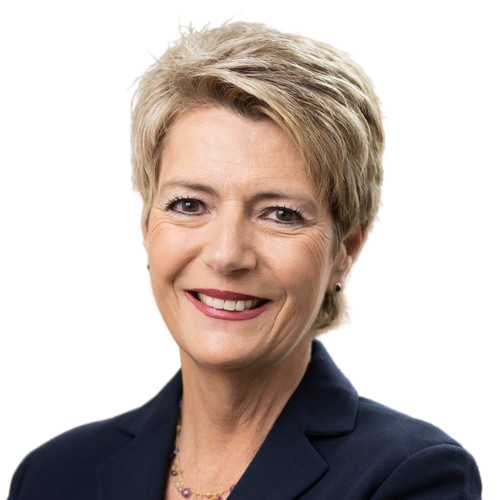
Hosted by
Karin Keller-Sutter
Federal Councillor & Head of the Federal Department of Finance, Switzerland

Jo Yeo
Director
Monetary Authority of Singapore
Jo is a Director and Division Head at the FinTech & Innovation Group (FTIG) at the Monetary Authority of Singapore (MAS). She leads the Payments Development and Data Connectivity Office, responsible for shaping Singapore's payments ecosystem and driving payments development initiatives, alongside cross-border data connectivity.
Jo has led Singapore's most consequential payments infrastructure and policy projects, including PayNow Generation 2, the Singapore Payments Network (SPaN), Project Nexus — a multilateral solution connecting fast payment systems across countries — and PayNow's cross-border linkages with Thailand, India, and Malaysia. Other landmark initiatives include SGQR, Direct FAST, the Payments Council, and the digital payments transition from corporate cheques in Singapore. Earlier in FTIG, she served as project director and lead policy architect for the Payment Services Act.
Jo's career began in law, with experience as Assistant General Counsel at MAS and prior private practice at Allen & Gledhill and Amica Law.
Speaking at
-
3:30–4:30pmTue 23 JunWorkshopWorkshop Room, Level 1Open
Others
Breaking the Speed Barrier: How to Address the Structural Frictions in Cross-border Payments - Powered by Swift
-
 Edward BowlesGlobal Head of Government Relations & ESGWise
-
 Jo YeoDirectorMonetary Authority of Singapore
-
 Thomas LammerDeputy Head of SecretariatBIS Committee on Payments and Market Infrastructures
-
 Tom MuttonExecutive Director of Payments Innovation & FintechBank of England
-
 Mike TruterDirector, Head of Industry EngagementSwiftModerator
About this session
Cross-border payments are the lifeblood of the global economy, underpinning trade, remittances, investment and financial connectivity. As technology has advanced and economies have become increasingly interconnected, expectations for international transfers have evolved too. Progress has been made, with 75% of payments travelling over Swift reaching destination banks within just 10 minutes. But frictions remain, particularly at the ‘last mile’ of a payments journey, where 80% of the total time is spent before it is credited to the end account or wallet.
Emerging technologies, including blockchain, promise a real-time, 24/7 reality. But innovation in cross-border payments will not come from new rails alone. It will emerge from steady progress in resolving structural frictions - improving data quality, harmonising standards, strengthening coordination and enhancing transparency across the value chain.
In this interactive session hosted by Swift, experts will discuss the structural frictions identified in Swift’s Payment Optimisation Index and provide practical insights on what institutions can do to improve the overall speed and transparency of cross-border payments.
-
-
8:40–9:55amWed 24 JunWorkshopWorkshop Room, Level 1Invite-OnlyModerator
Others
Design Thinking Workshop: Forging P2M Interoperability
-
Jo YeoDirectorMonetary Authority of SingaporeModerator
-
 Lawrence ChanGroup Chief Executive OfficerNetwork for Electronic Transfers (Singapore)Moderator
About this session
Merchants today operate in a global marketplace where customers expect seamless payment experiences across borders and currencies. Yet, fragmented payment rails and incompatible acceptance infrastructure continue to create friction, leaving merchants to navigate a maze of disconnected solutions. Achieving interoperability in cross-border merchant payments (P2M) remains elusive, as technical barriers and commercial interests perpetuate silos that undermine efficiency and trust.
While consensus exists that interoperability is desirable, the critical question is how to make interoperable P2M both commercially viable and technically sustainable across jurisdictions.
This design thinking workshop at Point Zero Forum (PZF) builds on the inaugural session at the GFTN Forum Japan, where senior stakeholders from financial services, fintechs, and policy circles convened to identify key challenges and opportunities. Preliminary recommendations from that dialogue included:
Commercial and Design Policies
· Creating merchant-friendly universal standards for onboarding and settlement models
· Designing incentives to encourage adoption of interoperable systems
· Ensuring transparency of fees and predictability of settlement timelines
Technical Uplifts
· Addressing critical risks including AML, data protection, and privacy through design architecture
· Establishing robust API-driven technical architectures for P2M
· Leveraging emerging technologies such as DLT to simplify and streamline cross-border transactions
At PZF, participants will revisit these foundational insights and engage in deeper exploration of the commercial and technical dimensions of interoperability. The workshop will focus on aligning standards, rethinking incentive structures, and developing top two actionable recommendations per category (commercial/technical) that move the needle on P2M interoperability. These recommendations would be further tested and finessed at the third design thinking workshop at the Singapore FinTech Festival. A proposed outcome of the workshops is a policy Insights Report to be published by GFTN.
-
-
12:00–1:30pmWed 24 JunGFTN InsightsRoundtable Room 1, Ground FloorOpen
Blueprint for Digital Assets
Global Stablecoin Regulatory Frameworks: From Principles to Practice
-
 Emma ButterworthHead of Innovation & Payments PolicyBank of England
-
 Eszter MajorLawyerState Secretariat for International Finance
-
Jo YeoDirectorMonetary Authority of Singapore
-
 Kwadwo BotweFintech SupervisorBank of Ghana
-
 Marianne BecharaSenior CounselInternational Monetary Fund
-
 Matthew OsborneDirector of Policy for EuropeRipple
-
 Nick GershSenior Regulatory CounselPaxos
-
 Patrick HansenSenior Director, EU Strategy & PolicyCircle
-
 Peter GoodrichMember of SecretariatFinancial Stability Board
-
 Peter KerstensAdvisor, DG FISMAEuropean Commission
-
 Stephanie CabossiorasChief Strategy & Global Policy OfficerSociete Generale-FORGE
-
 Jannah PatchayExecutive in Residence & Board MemberGlobal Digital FinanceModerator
About this session
The January 2026 publication of the GDF Global Stablecoin Regulatory Playbook marked a pivotal moment in the evolution of digital asset oversight. For the first time, a comprehensive, principles-based framework has been developed, by and for stablecoin issuers, to establish shared terminology, foundational concepts, and outcome-oriented principles for stablecoin regulation across jurisdictions.
Yet the core challenge identified by the Playbook remains urgent: despite growing convergence on broad objectives, significant divergence persists in legal classification, terminology, reserve requirements, and redemption standards across the US (GENIUS Act), EU (MiCA), UK, Singapore, UAE, and beyond.
This fragmentation creates compliance burdens for global issuers, undermines cross-border scalability, and risks undercutting the very benefits - frictionless payments, financial inclusion, monetary efficiency - that stablecoins are positioned to deliver.
This roundtable convenes regulators, policymakers, and senior industry participants to analyse the GDF Playbook's findings, stress-test its recommendations against real regulatory experience, and identify actionable pathways toward greater international alignment.
Why Now?
Stablecoins have moved decisively from experiment to infrastructure. The GENIUS Act has established a federal US framework; MiCA has come into force across the EU; Singapore, Hong Kong, the UAE, and the UK have each enacted or are finalising their regimes. The window for shaping global interoperability, before these frameworks calcify into divergent silos, is narrow.
The GDF Playbook provides a neutral, issuer-grounded reference point from which regulators, policymakers, and industry can build shared understanding. This roundtable is designed to translate that reference point into regulatory action - identifying where equivalence determinations are ripe, where supervisory cooperation agreements should be deepened, and where international standard-setters should focus their attention.
-
-
2:00–3:30pmWed 24 JunGFTN InsightsRoundtable Room 1, Ground FloorOpenModerator
Next-Gen Transactions
The Great Convergence: Building Tomorrow's Integrated Payments Networks
-
 Agnès BastaertHead of Global Affairs & Strategic Development, EuropeAnt International
-
 Anubhav SharmaDeputy Chief - Partnerships, Business Development & MarketingNPCI International Payments Limited
-
 Bridget Rose Mesina-RomeroDirector, Payments Policy and Development DepartmentBangko Sentral ng Pilipinas
-
 Helena ForestEVP, Real Time Payments Product & CommercialMastercard
-
Lawrence ChanGroup Chief Executive OfficerNetwork for Electronic Transfers (Singapore)
-
 Marc SchluepHead of Banking OperationsSwiss National Bank
-
Mike TruterDirector, Head of Industry EngagementSwift
-
 Tim MoncrieffManaging Director of Visa Payments & Currencycloud & VP, Strategic Initiatives & Execution, Visa DirectVisa
-
Jo YeoDirectorMonetary Authority of SingaporeModerator
About this session
The consensus is clear: global payment networks see collaboration, not competition, as their path to future dominance. Major networks are already building bridges – Mastercard with Ant International, Swift with blockchain layers, NGP's Nexus connecting instant payment systems worldwide. But as these technical integrations accelerate, a critical question emerges: what policy frameworks will govern this interconnected future?
When payment networks interoperate across borders, whose rules apply? How do regulators ensure consumer protection when a transaction touches multiple jurisdictions and networks? As networks become more interdependent, how do policymakers balance innovation with systemic risk? And perhaps most importantly – how can policy frameworks evolve to support beneficial network effects while preventing any single player from wielding excessive market power?
This roundtable brings together payment network leaders, financial regulators, and policy experts to explore how regulatory frameworks must adapt to govern an era of payment network collaboration. The stakes are high: get the policy right, and we unlock unprecedented efficiency and inclusion in global payments. Get it wrong, and we risk creating new systemic vulnerabilities or stifling the very innovation that promises to transform how the world moves money. -

