

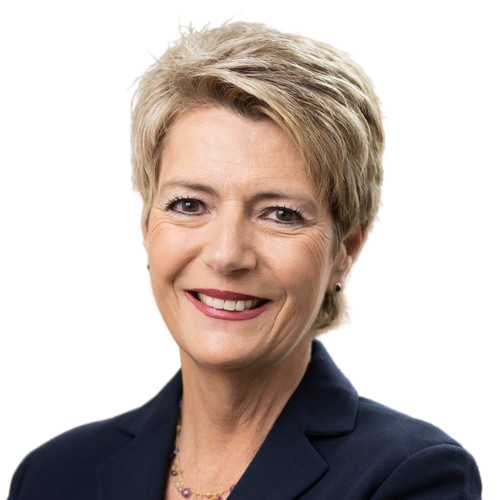
Hosted by
Karin Keller-Sutter
Federal Councillor & Head of the Federal Department of Finance, Switzerland

Liam Glennon
Head of North America Financial Institutions
TRM Labs
Liam Glennon is Head of North America Financial Institutions at TRM Labs, the blockchain intelligence company, where he helps financial institutions prevent crypto-related financial crime while safely embracing innovation and tokenization. He previously led Accenture's U.S. federal digital assets practice, advising the SEC, CFTC, Treasury, and DOJ, and supported IOSCO's DeFi and AI initiatives. With commercial experience designing digital asset ETPs and derivatives, Liam speaks on privacy, blockchain analytics, and digital asset markets, and is cited in a16z's Tornado Cash amicus brief. He holds a B.B.A. in Finance and minor in Analytics.
Speaking at
-
4:00–5:30pmTue 23 JunGFTN InsightsRoundtable Room 2, Ground FloorOpen
Bridging the Financial Gap
Solving for the Fundamentals: Identity Wallets, Trust Infrastructure, and Preparing for the Agentic Economy
-
 Aoife HoulihanVice President, Government AffairsVisa
-
 Bridget Rose Mesina-RomeroDirector, Payments Policy and Development DepartmentBangko Sentral ng Pilipinas
-
 Christina WuLead, Global Policy and Regulatory Strategy, EMEACircle
-
 Felix LaufenbergOpen Transaction Layer LeadFireblocks
-
 Gary LiuCo-Founder & Chief Executive OfficerTerminal 3
-
 Guillermo Galicia RabadanFinancial Sector Specialist - Payment Systems Development GroupThe World Bank
-
 Liam GlennonHead of North America Financial InstitutionsTRM Labs
-
 Livia BenistyChief External Affairs OfficerBanking Circle
-
 Mai FujimotoCo-FounderzERC20
-
 Dr. Nicolas JacquemartChief Legal OfficerCardano Foundation
-
 Vedran LalicSenior Digital Identity and Trust Services AdvisorThe United Nations University-EGOV
-
 Ivan Mortimer-SchuttsGlobal Head of vLEIGlobal Legal Entity Identifier Foundation (GLEIF)Moderator
About this session
By the end of 2026, all EU member states will be required to issue the European Digital Identity Wallet (EUDI), with a goal of achieving 80% voluntary adoption by 2030.
While much of the current focus has been on user adoption and interoperability, a more fundamental shift in the economy is underway: the rise of AI agents capable of acting, transacting, and coordinating on behalf of individuals and businesses. This raises a critical question: how can these agents be trusted to act, transact, and take decisions safely across platforms and jurisdictions?
Identity-wallets and verifiable credentials hold the potential to become foundational trust infrastructure that unlocks this shift, by authenticating identity, delegating authority from human to agent, and resolving KYC and liability questions. With the right design choices today, the EUDI could evolve into a global benchmark not just for digital identity, but for programmable, interoperable trust.
Yet, critical questions remain around adoption, sustainable business models, and resilience to emerging technological risks. As the deadline draws closer, this roundtable will convene financial institutions, digital identity and verifiable credentials providers, technologists, and policymakers to examine key design and coordination challenges and trade-offs facing identity wallet ecosystems today. -
-
3:00–3:30pmWed 24 JunWorkshopWorkshop Room, Level 1OpenModerator
Others
AI and Blockchain: Powering Innovation, Managing Risk, Shaping the Future - Powered by TRM Labs
-
 Dr. Anika SchumannLead for AI RiskSwiss Financial Market Supervisory Authority (FINMA)
-
 Prof. Chris BrummerChief Executive OfficerFintech Foundation
-
 Geraldine KraevGlobal Innovation ManagerFCA
-
 Louise JohnstonDirector, Government Affairs & PolicyMastercard
-
 Rene MichauGlobal Head, Digital AssetsStandard Chartered
-
 Steven McWhirterGlobal Policy LeadBinance
-
Liam GlennonHead of North America Financial InstitutionsTRM LabsModerator
About this session
AI is driving progress across all sectors, including blockchain-powered financial services—accelerating efficiency and unlocking analytical capabilities that would have been unthinkable just a few years ago. The same capabilities transforming financial services are equally critical in managing the risks that come with them—from financial crime and illicit flows to smart contract vulnerabilities, operational and custody failures, and emerging threats to market integrity.
In this interactive workshop, leaders from financial intelligence, digital infrastructure, and global regulation come together to share what AI-powered risk management looks like on the ground today—the wins, the lessons, and the open questions. Rather than debating frameworks, this session will allow for honest exchange: what's being built, how it's landing, and what the path to responsible, explainable AI adoption might need from policymakers tomorrow.
This session aims to define the urgent, concrete steps needed to make AI-powered risk management a foundation — not an afterthought — of the digital economy.
-
-
1:40–2:20pmThu 25 JunForum StageKongresssaal, Level 1Open
Blueprint for Digital Assets
From Law to Operations: The Digital Asset Ecosystem's New Reality
-
 Carlos ConesaAssociate Director General Operations, Markets and Payment SystemsBank of Spain
-
 Julian BiegmannGeneral Manager SwitzerlandRevolut Switzerland
-
Liam GlennonHead of North America Financial InstitutionsTRM Labs
-
 Tero ReunaChief Executive Officer, Paxos Issuance EuropePaxos
-
 Ceridwen ChooChief Executive OfficerCleanverse International Pte LtdModerator
About this session
Regulation is one thing; implementing new rules across live systems, global entities, and market infrastructures is another entirely. While firms grapple with operationalising evolving regimes such as MiCA and the GENIUS Act, policymakers and standard-setting bodies are simultaneously reshaping the principles that underpin tomorrow's financial market infrastructures (FMI).
This session brings together policymakers, central bankers, and industry practitioners to examine where gaps between policy intent, global standards, and operational reality are widest, how industry, policymakers, and regulators can better coordinate in an environment where rules and infrastructure are being built in parallel, and what the future of the institutional digital assets ecosystem will look like. -

