

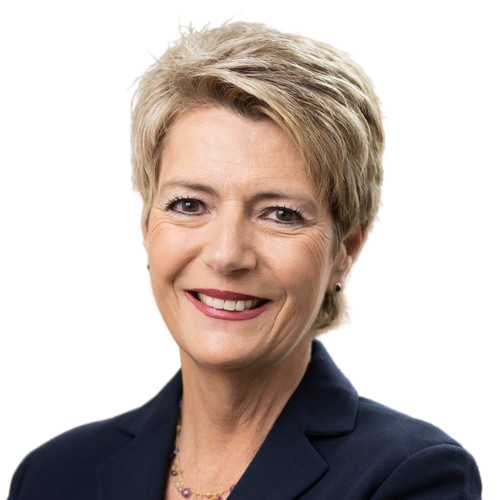
Hosted by
Karin Keller-Sutter
Federal Councillor & Head of the Federal Department of Finance, Switzerland

Isadora Arredondo
Vice President, Global Policy
Hedera
Isadora Arredondo is VP of Global Policy at Hedera, where she leads global engagement with regulators, policymakers, and industry stakeholders at the intersection of technology, finance, and public policy. She brings 10+ years of experience working in both the public and private sectors, more recently working as an advisor to leading financial institutions, investors, and tech companies on regulatory and policy issues across the EU and UK. Previously, she worked at the UK’s Financial Conduct Authority, where she developed regulatory policy for investment, payments, and digital assets firms.
Her early career included roles at the OECD’s Observatory for Public Sector Innovation, BCG, and the Economist Intelligence Unit, where she led policy-focused thought leadership across EMEA, US and Latam. She holds an MBA-accredited degree from Imperial College Business School and an MsC in Politics and Communications from the London School of Economics.
Speaking at
-
5:05–5:45pmTue 23 JunForum StageKongresssaal, Level 1Open
Blueprint for Digital Assets
On-Chain Settlement: The Infrastructure for Atomic Finality
-
 Emanuel VilaDirector, Strategy and Innovation, CEO OfficeCLS Services
-
 Isadora ArredondoVice President, Global PolicyHedera
-
 Ryan HaywardManaging Director, Digital AssetsBarclays
-
 Sébastien Van CampenhoudtDirector, Innovation & Digital Assets, Tokenized Cash LeadEuroclear
-
 Tim WaySenior Director, Global Banking Initiatives LeadFireblocks
-
 Laura NavaratnamUK Policy LeadCrypto Council for InnovationModerator
About this session
The promise of blockchain settlement has always been atomicity - simultaneous exchange of asset and payment, with finality in seconds rather than days. Live pilots from major exchanges, custodians, and correspondent banks are proving the technology works; the harder challenge is rebuilding the legal frameworks, operational workflows, and legacy infrastructure that surround it. This session examines what it genuinely takes to move from today's T+1 standard to a world where settlement is instantaneous, global, and always on.
-
-
2:00–3:30pmThu 25 JunGFTN InsightsRoundtable Room 3, Ground FloorOpen
Blueprint for Digital Assets
Navigating the New Digital Order: Regulatory Divergence, Monetary Architecture, and a Path toward Coordination
-
 Audrey MetzgerDirector of Innovation & Financial Market InfrastructuresBanque de France
-
 Dante DisparteChief Strategy Officer and Head of Global Policy & OperationsCircle
-
Isadora ArredondoVice President, Global PolicyHedera
-
 Jessica RenierManaging Director & Head of Digital FinanceInstitute of International Finance (IIF)
-
 Karim MouaffakFinancial Sector SpecialistArab Monetary Fund
-
 Dr. Michael HuertasPartner, Global FS Legal LeaderPwC Legal
-
 Mykolas MajauskasGlobal Head of PolicyBybit
-
 Natalya ThakurFounder & Chief Executive OfficerKnova
-
 Pavle AvramovicDirector of Research & PolicyFinancial Innovation for Impact
-
 Prof. Sarah HammerCo-ChairBretton Woods Committee Working Group on AI
-
 Thorsten PauliCountry Executive Switzerland, & Head Equity Capital Markets DACHBank of America
-
 Emily SlaterExecutive DirectorBretton Woods CommitteeModerator
About this session
Digital assets, programmable money, and AI-driven transactions are crossing borders at increased speed. But the rules governing them are being written jurisdiction by jurisdiction, with no shared architecture in sight. As the US advances GENIUS Act rules for private-sector stablecoins, the EU deepens MiCA and pursues a digital euro, and China scales its state-backed e-CNY, three major economies are building divergent governance frameworks around one underlying technology — with significant implications for cross-border payments, monetary policy transmission, and AI in the global financial system.
This policy divergence is a compliance challenge for market participants, but it is also the early stage of a structural buildup. When domestically rational policy choices generate internationally costly spillovers — and when no coordinating mechanism exists to manage them — fragmentation compounds over time until the cost of inaction becomes prohibitive. Digital currencies and AI governance are following this trajectory, and while the window to get ahead of it remains open, it is closing.
Against this backdrop, the Bretton Woods Committee will convene a closed roundtable at Point Zero Forum on Thursday, June 25th to bring together global policymakers, central bankers, regulators, and private sector leaders to stress-test the diagnosis. This discussion will directly inform the Bretton Woods Committee's upcoming work, with a focus on the defining digital governance challenge of the moment: whether coordination across jurisdictions can accelerate to match the digital rails being built beneath the global financial system.
The roundtable will be a 90-minute discussion featuring 10 minutes of scene-setting remarks from featured speakers, followed by an open exchange among the broader group. A brief framing paper will be circulated in advance. The core question animating the discussion: What are the costs of continued fragmentation — and what global coordination mechanisms are necessary to manage the associated risks and opportunities?
-

