
.svg)
Hosted by
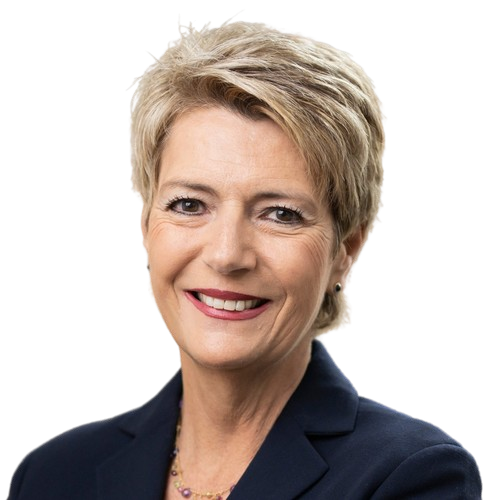
Karin Keller-Sutter
Federal Councillor & Head of the Federal Department of Finance, Switzerland

Dr. Michael Blaschke
Co-Host, Head of Partnerships
Bitcoin, Fiat, & Rock'n'Roll (BFRR)
Dr. Michael R. Blaschke is Principal and IT Architect at SAP's Digital Currency Hub and Co-Host of the institutional DLT podcast "Bitcoin, Fiat & Rock'n'Roll." In his current role at SAP, he architects enterprise solutions that integrate stablecoins into existing ERP payment processes, enabling instant cross-border settlement around the clock, independent of traditional banking cut-off times. His work spans the integration of licensed crypto asset service providers with SAP's Multi-Bank Connectivity layer, supporting institutional adoption of digital currencies such as USDC, PYUSD, and EURAU across Ethereum and Polygon networks.
As Co-Host of "Bitcoin, Fiat & Rock'n'Roll," Michael facilitates the dialogue between traditional financial institutions, regulators, and the emerging digital currency ecosystem. The podcast provides an institutional lens on the evolution of money, payment infrastructure, and the regulatory frameworks shaping digital finance in Europe and beyond.
Prior to SAP, Michael served as a top-management consultant at A.T. Kearney's Digital and Analytics practice, advising executive-level, cross-functional teams on digital strategy and technology transformation in financial services. His ten years of international experience across IT architecture and strategic consulting give him a distinctive ability to bridge the gap between technological possibility and practical institutional implementation.
Michael holds a Ph.D. in Information Systems from the University of St.Gallen (HSG) and the London School of Economics (LSE), with foundational research supported by the Swiss National Science Foundation. His academic work has been published in proceedings of leading international conferences and journals. He currently serves as Lecturer at HSG, where he continues to contribute to the academic discourse on digital platforms and institutional technology adoption. He is also a Certified Cloud Architect.
Speaking at
-
2:00–3:30pmTue 23 JunGFTN InsightsRoundtable Room 2, Ground FloorOpen
Blueprint for Digital Assets
The Future of Commercial Bank Money On-Chain
-
 Alex GluchowskiCo-founder & Chief Executive OfficerMatter Labs | ZKsync
-
 Andrew BrinsonChief Operating OfficerPave Bank
-
 Aymeric SalleyHead of Digital Assets PlatformBanking Circle
-
 Daniel NagyDirectorForefront
-
 Keisuke KimuraVice PresidentJapan Cryptoasset Business Association
-
 Mai KanekoInternational Business LeadDeCurret DCP Inc.
-
 Manuel KleinHead of Market Management Payments & Digital CurrenciesDeutsche Bank
-
 Martin BrunckoCo-Founder & Chief Executive OfficerSchuman Financial
-
 Dr. Michael BlaschkeCo-Host, Head of PartnershipsBitcoin, Fiat, & Rock'n'Roll (BFRR)
-
 Sébastien Van CampenhoudtDirector, Innovation & Digital Assets, Tokenized Cash LeadEuroclear
-
 Erwin VoloderDirector, Research & StrategyBlockchain For EuropeModerator
About this session
As the adoption of stablecoins accelerates globally, policymakers and financial institutions are confronting a deeper structural question: what form of money will anchor the next generation of digital finance?
Deposit tokens have emerged as one of the leading responses to this challenge, combining the safeguards of the traditional banking system with the programmability and efficiency of distributed ledger technology. However, despite growing institutional interest, most initiatives remain confined to pilots and closed networks, even as stablecoins rapidly achieve scale, distribution, and integration across digital asset ecosystems.
This roundtable brings together banks, infrastructure providers, and financial institutions to examine the challenges that constrain adoption of tokenized deposits, and the extent to which deposit tokens will coexist with or compete against stablecoins and other forms of digital money. It will also explore the growing push by jurisdictions worldwide to develop local-currency stablecoins as a strategic counterweight to dollar-denominated instruments and what these twin approaches - local currency stablecoins vis-a-vis on-chain commercial bank money - mean for the future shape of digital money.
Critically, the discussion will pose a broader strategic questio: whether tokenized commercial bank deposits can provide a sovereign and trusted foundation for the digital economy, or whether the future of digital money will be predominantly shaped by private stablecoin ecosystems, and the role of jurisdiction-specific stablecoin models therein.
-

